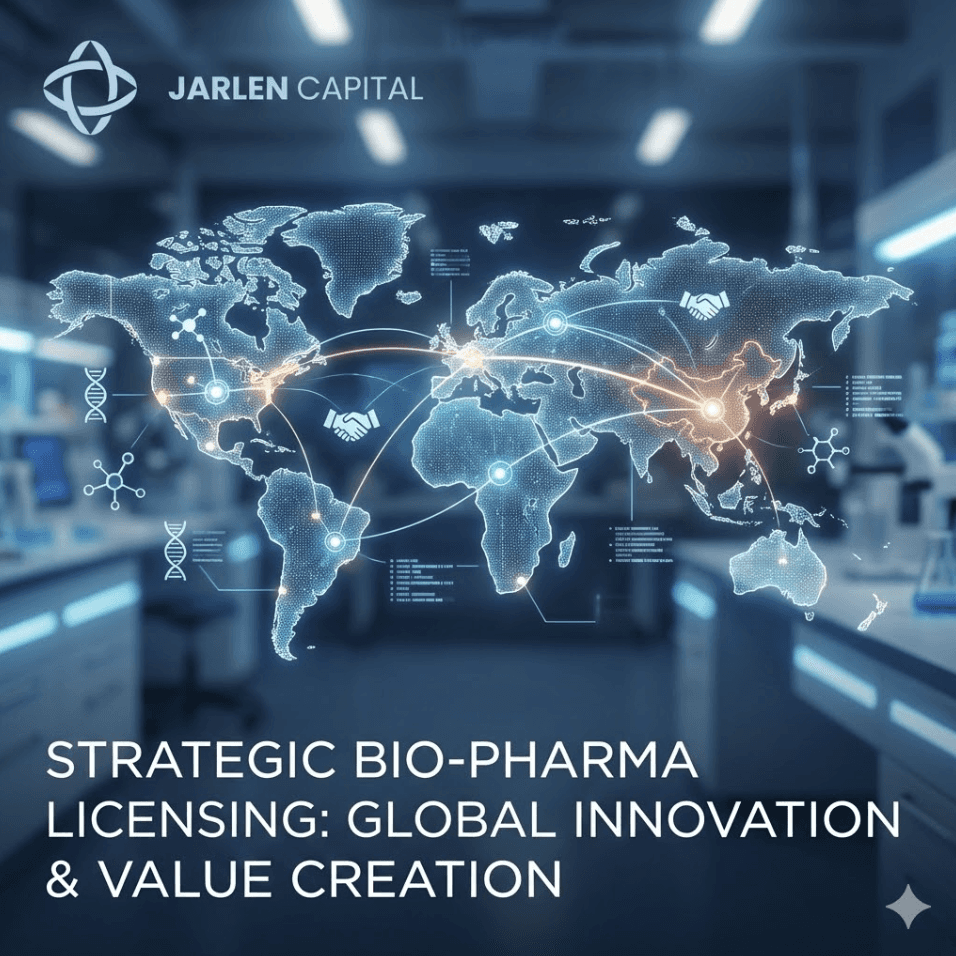
Strategic Bio-Pharma Licensing: Global innovation & Value creation.
Author:
Author:
Author:
Date:
Date:
Date:


Executive Summary: Macro-Strategic Overview
The biopharmaceutical sector entered 2025 with an unprecedented level of liquidity, with dry powder estimates exceeding $1.5 trillion across top tier pharma companies.
Unlike previous cycles characterized by speculative deployment, 2025 has been defined by strategic discipline and high conviction capital allocation.
Following a period of volatility in 2024, the industry has pivoted toward high value, late stage asset acquisition.
This shift is driven partially by the looming Patent Cliff, where over $200 billion in revenue is projected to face Loss of Exclusivity (LoE) by 2030.
Major pharmaceutical entities are effectively compelled to replace this revenue, shifting focus from early stage R&D exploration to commercial ready or late clinical asset integration.
While total transaction volume has consolidated relative to the peaks of 2020 and 2021, aggregate deal value has surged, indicating a "quality over quantity" thesis. In the third quarter of 2025 alone, biopharma licensing deal values reached $63.7 billion. Year to date licensing value stands at $183.7 billion, underscoring the sector's reliance on external innovation to bolster pipelines. Simultaneously, venture capital deployment has remained selective, totaling $17.1 billion year to date across the biopharma sector, favoring de risked clinical assets over preclinical platforms.
Cross-Border Innovation: The China Structural Inversion
Historically, China served primarily as a commercial market for Western therapeutics, but in 2025, this dynamic has structurally inverted. China has emerged as a premier source of global innovation, with Chinese biotechs increasingly acting as the licensors or innovators rather than licensees.
Data indicates that by the first quarter of 2025, 32% of global out licensing deal value originated from Chinese firms, a significant increase from approximately 21% in prior years. This trend is driven by a stark arbitrage opportunity where Western Pharma can acquire validated, best-in-class assets from Chinese developers, who face constrained domestic capital markets at valuations significantly more attractive than comparable US sourced assets.
The aggregate value of cross border licensing involving Chinese assets grew exponentially from $3.1 billion in previous cycles to over $57.1 billion in 2024, with momentum continuing through 2025. This surge is concentrated in high-complexity modalities, specifically monoclonal antibodies and ADCs, where Chinese engineering has demonstrated global competitiveness.
Therapeutic Focus: The ADC Renaissance
Antibody-Drug Conjugates (ADCs) have established themselves as a cornerstone of modern oncology portfolios. The focus in 2025 has shifted toward bispecific ADCs, which are next-generation constructs capable of dual-antigen targeting to overcome resistance mechanisms. A prime example is the transaction between Bristol Myers Squibb and SystImmune .
This deal exemplifies the high value, high-conviction deal structures dominating the market. The asset, BL-B01D1 , is a fic bispecific ADC targeting EGFR and HER3.
Bristol Myers Squibb committed $800 million in upfront capital, and in October 2025, a $250 million payment was triggered upon the initiation of the IZABRIGHT-Breast01 study.
The total deal potential reaches up to $8.4 billion.
Positive Phase 3 topline results in nasopharyngeal carcinoma reported in late 2025 have further validated the asset, generating significant interest from global clinical bodies.
Similarly, Pfizer executed a significant strategic move to secure a "China-for-China, Pfizer-for-Global" asset split with 3SBio.
The asset, SSGJ-707, is a bispecific antibody targeting PD-1 and VEGF.
Pfizer paid $1.25 billion upfront and made a $100 million strategic equity investment in 3SBio, bringing the total potential value to $4.8 billion.
Pfizer has committed to manufacturing the drug substance and product within the United States, specifically in North Carolina and Kansas, mitigating supply chain risks associated with geopolitical friction.
Metabolic Market Expansion: The "NewCo" Model
The GLP-1 receptor agonist market continues to drive valuation premiums.
To access this high-growth vertical while navigating geopolitical complexities, the industry has adopted the "NewCo" asset spin out model.
This strategy is perfectly illustrated by the transaction between Hengrui Pharma and Kailera Therapeutics. Hengrui Pharma spun out its metabolic portfolio into a newly formed US entity, Kailera Therapeutics, backed by top tier US investors including Bain Capital and Atlas Venture.
Kailera raised $400 million in a Series A in October 2024 and followed up with a $600 million Series B in October 2025, bringing total raised capital to $1 billion in just 12 months. The lead asset, KAI-9531, is a dual GLP-1/GIP receptor agonist demonstrating competitive efficacy with 17-18% weight loss in Phase 3 trials.
This structure "Americanizes" the asset, facilitating US clinical trials and a potential US IPO, while allowing the originator, Hengrui, to retain significant equity (19.9%) and milestone upside.
Regulatory & Geopolitical Landscape
The Federal Trade Commission (FTC) has maintained an aggressive posture regarding large scale consolidation.
Consequently, "mega-mergers" exceeding $100 billion have effectively ceased.
This regulatory friction has redirected capital toward licensing partnerships and asset acquisitions, which generally incur lower antitrust scrutiny than whole-company buyouts.
Simultaneously, legislative pressure on US-China supply chain integration culminated in the passage of the BIOSECURE Act as part of the FY 2026 National Defense Authorization Act (NDAA) in December 2025. The Act restricts US companies from contracting with "biotechnology companies of concern" for manufacturing and services. Companies now face a mandated decoupling of supply chains, necessitating the migration of CDMO relationships to US, European, or Indian partners. However, to ensure continuity of care, existing contracts are protected under a five-year wind-down period through 2032. A distinct dichotomy has emerged: while physical supply chains are decoupling, the transfer of Intellectual Property (IP) remains robust, as evidenced by the record licensing volumes.
Deal Structuring & Strategic Models
In response to clinical and regulatory uncertainty, deal structures have evolved to favor option-based agreements. Acquirers pay a premium upfront fee, often around 7% of total value, for the exclusive right to license an asset pending Phase 1 or Phase 2 data readouts. This preserves capital and provides downside protection, allowing major pharma players to "audit" innovation before fully committing balance sheet resources.
Following the Kailera precedent, the "NewCo" structure has become a standard vehicle for cross border value creation. By domiciling assets in neutral jurisdictions such as Delaware or the Cayman Islands and capitalizing them with Western VC funds, originators can bypass geopolitical discount factors and access deep US capital markets.
Capital Markets & Liquidity
Venture investment has stabilized at $17.1 billion year-to-date, but allocation is highly bifurcated. Capital is concentrating in "flight to quality" assets, specifically clinical-stage programs in oncology ADCs and metabolic disease.
Preclinical platforms lacking human proof-of-concept data face a challenging fundraising environment, driving consolidation.
The IPO window remains constrained, with only 7 biopharma IPOs pricing in the first three quarters of 2025, raising a modest $1.1 billion. With public exit routes narrowed, M&A remains the primary liquidity event for investors. This dynamic provides acquirers with significant leverage to negotiate favorable terms, often structuring deals with heavy backend milestones rather than upfront cash.
Strategic Outlook: 2026 and Beyond
As the sector moves into 2026, several structural trends are anticipated. The "NewCo" model will likely accelerate, with 5 to 10 additional high-profile spin-outs expected as Chinese pharma majors utilize this vehicle to unlock the value of their pipelines in Western markets. Investment will migrate toward increasingly complex modalities, including Radio-ADCs and Immune-Stimulating ADCs (ISACs), following the bispecific trend set in 2025.
Furthermore, the implementation of the BIOSECURE Act will trigger a "capacity crunch" in Western CDMOs as companies race to secure non China manufacturing slots.
Finally, early indicators suggest a rotation of capital into Neuroscience, driven by validated targets in Alzheimer’s and Schizophrenia, mirroring the intensity seen in Oncology over the past decade.
Reference Table: Major Transactions (2024-2025)
Acquirer / Licensee | Licensor / Origin | Asset / Mechanism | Deal Value (Potential) | Upfront Payment | Strategic Rationale |
Bristol Myers Squibb | SystImmune (Biokin) | BL-B01D1 (EGFRxHER3 Bispecific ADC) | $8.4 Billion | $800M (+$250M Milestone) | Securing first-in-class bispecific ADC capabilities. |
Pfizer | 3SBio | SSGJ-707 (PD-1xVEGF Bispecific) | ~$4.8 Billion | $1.25 Billion (inc. equity) | Strategic portfolio addition with US manufacturing plan. |
Kailera Tx (NewCo) | Hengrui Pharma | KAI-9531 (GLP-1/GIP) | ~$6 Billion | Equity + Milestones | "NewCo" model to access US capital markets. |
GSK | Hengrui Pharma | Multiple Assets (RI&I / Oncology) | $12.5 Billion | $500 Million | Large-scale portfolio integration. |
Sources
McKinsey & Company. (2025). China Biopharma Dealmaking Trends: From In-licensing to Out-licensing.
IQVIA Institute. (2024). Global Trends in R&D and Partnering.
Dacin, M. T., Oliver, C., & Roy, J. P. (2007). The Legitimacy of Strategic Alliances: An Institutional Perspective. Strategic Management Journal.
Spence, M. (1973). Job Market Signaling. The Quarterly Journal of Economics.
Executive Summary: Macro-Strategic Overview
The biopharmaceutical sector entered 2025 with an unprecedented level of liquidity, with dry powder estimates exceeding $1.5 trillion across top tier pharma companies.
Unlike previous cycles characterized by speculative deployment, 2025 has been defined by strategic discipline and high conviction capital allocation.
Following a period of volatility in 2024, the industry has pivoted toward high value, late stage asset acquisition.
This shift is driven partially by the looming Patent Cliff, where over $200 billion in revenue is projected to face Loss of Exclusivity (LoE) by 2030.
Major pharmaceutical entities are effectively compelled to replace this revenue, shifting focus from early stage R&D exploration to commercial ready or late clinical asset integration.
While total transaction volume has consolidated relative to the peaks of 2020 and 2021, aggregate deal value has surged, indicating a "quality over quantity" thesis. In the third quarter of 2025 alone, biopharma licensing deal values reached $63.7 billion. Year to date licensing value stands at $183.7 billion, underscoring the sector's reliance on external innovation to bolster pipelines. Simultaneously, venture capital deployment has remained selective, totaling $17.1 billion year to date across the biopharma sector, favoring de risked clinical assets over preclinical platforms.
Cross-Border Innovation: The China Structural Inversion
Historically, China served primarily as a commercial market for Western therapeutics, but in 2025, this dynamic has structurally inverted. China has emerged as a premier source of global innovation, with Chinese biotechs increasingly acting as the licensors or innovators rather than licensees.
Data indicates that by the first quarter of 2025, 32% of global out licensing deal value originated from Chinese firms, a significant increase from approximately 21% in prior years. This trend is driven by a stark arbitrage opportunity where Western Pharma can acquire validated, best-in-class assets from Chinese developers, who face constrained domestic capital markets at valuations significantly more attractive than comparable US sourced assets.
The aggregate value of cross border licensing involving Chinese assets grew exponentially from $3.1 billion in previous cycles to over $57.1 billion in 2024, with momentum continuing through 2025. This surge is concentrated in high-complexity modalities, specifically monoclonal antibodies and ADCs, where Chinese engineering has demonstrated global competitiveness.
Therapeutic Focus: The ADC Renaissance
Antibody-Drug Conjugates (ADCs) have established themselves as a cornerstone of modern oncology portfolios. The focus in 2025 has shifted toward bispecific ADCs, which are next-generation constructs capable of dual-antigen targeting to overcome resistance mechanisms. A prime example is the transaction between Bristol Myers Squibb and SystImmune .
This deal exemplifies the high value, high-conviction deal structures dominating the market. The asset, BL-B01D1 , is a fic bispecific ADC targeting EGFR and HER3.
Bristol Myers Squibb committed $800 million in upfront capital, and in October 2025, a $250 million payment was triggered upon the initiation of the IZABRIGHT-Breast01 study.
The total deal potential reaches up to $8.4 billion.
Positive Phase 3 topline results in nasopharyngeal carcinoma reported in late 2025 have further validated the asset, generating significant interest from global clinical bodies.
Similarly, Pfizer executed a significant strategic move to secure a "China-for-China, Pfizer-for-Global" asset split with 3SBio.
The asset, SSGJ-707, is a bispecific antibody targeting PD-1 and VEGF.
Pfizer paid $1.25 billion upfront and made a $100 million strategic equity investment in 3SBio, bringing the total potential value to $4.8 billion.
Pfizer has committed to manufacturing the drug substance and product within the United States, specifically in North Carolina and Kansas, mitigating supply chain risks associated with geopolitical friction.
Metabolic Market Expansion: The "NewCo" Model
The GLP-1 receptor agonist market continues to drive valuation premiums.
To access this high-growth vertical while navigating geopolitical complexities, the industry has adopted the "NewCo" asset spin out model.
This strategy is perfectly illustrated by the transaction between Hengrui Pharma and Kailera Therapeutics. Hengrui Pharma spun out its metabolic portfolio into a newly formed US entity, Kailera Therapeutics, backed by top tier US investors including Bain Capital and Atlas Venture.
Kailera raised $400 million in a Series A in October 2024 and followed up with a $600 million Series B in October 2025, bringing total raised capital to $1 billion in just 12 months. The lead asset, KAI-9531, is a dual GLP-1/GIP receptor agonist demonstrating competitive efficacy with 17-18% weight loss in Phase 3 trials.
This structure "Americanizes" the asset, facilitating US clinical trials and a potential US IPO, while allowing the originator, Hengrui, to retain significant equity (19.9%) and milestone upside.
Regulatory & Geopolitical Landscape
The Federal Trade Commission (FTC) has maintained an aggressive posture regarding large scale consolidation.
Consequently, "mega-mergers" exceeding $100 billion have effectively ceased.
This regulatory friction has redirected capital toward licensing partnerships and asset acquisitions, which generally incur lower antitrust scrutiny than whole-company buyouts.
Simultaneously, legislative pressure on US-China supply chain integration culminated in the passage of the BIOSECURE Act as part of the FY 2026 National Defense Authorization Act (NDAA) in December 2025. The Act restricts US companies from contracting with "biotechnology companies of concern" for manufacturing and services. Companies now face a mandated decoupling of supply chains, necessitating the migration of CDMO relationships to US, European, or Indian partners. However, to ensure continuity of care, existing contracts are protected under a five-year wind-down period through 2032. A distinct dichotomy has emerged: while physical supply chains are decoupling, the transfer of Intellectual Property (IP) remains robust, as evidenced by the record licensing volumes.
Deal Structuring & Strategic Models
In response to clinical and regulatory uncertainty, deal structures have evolved to favor option-based agreements. Acquirers pay a premium upfront fee, often around 7% of total value, for the exclusive right to license an asset pending Phase 1 or Phase 2 data readouts. This preserves capital and provides downside protection, allowing major pharma players to "audit" innovation before fully committing balance sheet resources.
Following the Kailera precedent, the "NewCo" structure has become a standard vehicle for cross border value creation. By domiciling assets in neutral jurisdictions such as Delaware or the Cayman Islands and capitalizing them with Western VC funds, originators can bypass geopolitical discount factors and access deep US capital markets.
Capital Markets & Liquidity
Venture investment has stabilized at $17.1 billion year-to-date, but allocation is highly bifurcated. Capital is concentrating in "flight to quality" assets, specifically clinical-stage programs in oncology ADCs and metabolic disease.
Preclinical platforms lacking human proof-of-concept data face a challenging fundraising environment, driving consolidation.
The IPO window remains constrained, with only 7 biopharma IPOs pricing in the first three quarters of 2025, raising a modest $1.1 billion. With public exit routes narrowed, M&A remains the primary liquidity event for investors. This dynamic provides acquirers with significant leverage to negotiate favorable terms, often structuring deals with heavy backend milestones rather than upfront cash.
Strategic Outlook: 2026 and Beyond
As the sector moves into 2026, several structural trends are anticipated. The "NewCo" model will likely accelerate, with 5 to 10 additional high-profile spin-outs expected as Chinese pharma majors utilize this vehicle to unlock the value of their pipelines in Western markets. Investment will migrate toward increasingly complex modalities, including Radio-ADCs and Immune-Stimulating ADCs (ISACs), following the bispecific trend set in 2025.
Furthermore, the implementation of the BIOSECURE Act will trigger a "capacity crunch" in Western CDMOs as companies race to secure non China manufacturing slots.
Finally, early indicators suggest a rotation of capital into Neuroscience, driven by validated targets in Alzheimer’s and Schizophrenia, mirroring the intensity seen in Oncology over the past decade.
Reference Table: Major Transactions (2024-2025)
Acquirer / Licensee | Licensor / Origin | Asset / Mechanism | Deal Value (Potential) | Upfront Payment | Strategic Rationale |
Bristol Myers Squibb | SystImmune (Biokin) | BL-B01D1 (EGFRxHER3 Bispecific ADC) | $8.4 Billion | $800M (+$250M Milestone) | Securing first-in-class bispecific ADC capabilities. |
Pfizer | 3SBio | SSGJ-707 (PD-1xVEGF Bispecific) | ~$4.8 Billion | $1.25 Billion (inc. equity) | Strategic portfolio addition with US manufacturing plan. |
Kailera Tx (NewCo) | Hengrui Pharma | KAI-9531 (GLP-1/GIP) | ~$6 Billion | Equity + Milestones | "NewCo" model to access US capital markets. |
GSK | Hengrui Pharma | Multiple Assets (RI&I / Oncology) | $12.5 Billion | $500 Million | Large-scale portfolio integration. |
Sources
McKinsey & Company. (2025). China Biopharma Dealmaking Trends: From In-licensing to Out-licensing.
IQVIA Institute. (2024). Global Trends in R&D and Partnering.
Dacin, M. T., Oliver, C., & Roy, J. P. (2007). The Legitimacy of Strategic Alliances: An Institutional Perspective. Strategic Management Journal.
Spence, M. (1973). Job Market Signaling. The Quarterly Journal of Economics.


We align BioPharma innovation, capital, and strategy cross borders.
We connect visionary researchers and impact-driven investors to shape the future of healthcare.

We align BioPharma innovation, capital, and strategy cross borders.
We connect visionary researchers and impact-driven investors to shape the future of healthcare.

We align BioPharma innovation, capital, and strategy cross borders.
We connect visionary researchers and impact-driven investors to shape the future of healthcare.